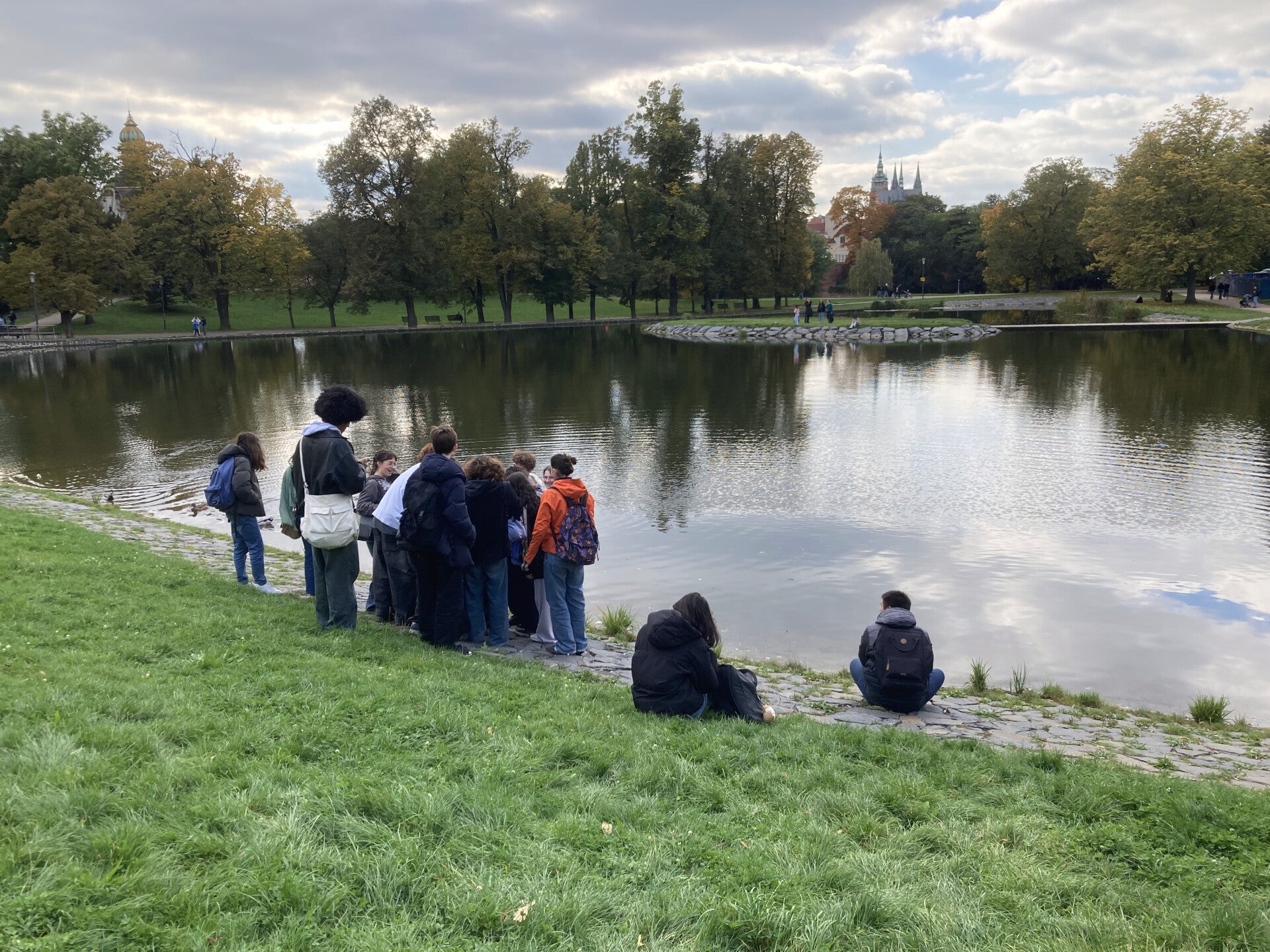
Section Internationale
Découvrez les avantages d'une éducation bilingue et interculturelle orientée vers le monde.
Qu'est-ce que la Section Internationale (SI) britannique ?
Les sections internationales constituent un dispositif bilingue et biculturel mis en œuvre par le ministère chargé de l’éducation nationale, en coopération avec des partenaires étrangers. Au sein du système français, elles intègrent un enseignement relevant non seulement de la langue, mais aussi de la culture et des méthodes pédagogiques du pays partenaire.
Les élèves de SI suivent une scolarité française à laquelle sont intégrés des enseignements spécifiques, leur permettant de suivre une formation poussée dans la langue du pays partenaire.
En Seconde SI (section internationale), les élèves suivent les mêmes enseignements que les élèves de Seconde générale, avec des cours spécifiques à la section britannique :
- 4 heures supplémentaires d'anglais / littérature anglophone par semaine (en plus des 3h d’anglais habituelles)
- un enseignement spécifique en histoire - géographie (2 h sont enseignées en anglais sur les 4h hebdomadaires)
En 1ère et Terminale, les enseignements de littérature anglophone et d’histoire-géographie sont reconnus comme équivalents aux A-levels britanniques.
Ce cursus prépare les élèves au Baccalauréat français international (BFI) en Terminale.
Pour plus de détails, consulter le site :
What’s an International Section?
International sections constitute a bilingual and bicultural program implemented by the French Ministry of Education in cooperation with foreign partners.
Within the French system, they provide instruction in the language, literature and culture of the partner country.
The International Sections prepare students for the BFI (Baccalauréat français international), a unique bilingual and bicultural school-leaving qualification based on the French Baccalaureate.
What is the BFI for the British Section?
- It’s the British version of the Baccalauréat Français International (BFI).
- It combines the breadth and rigour of the Baccalaureate with extra subjects taught and examined in English to A-Level standard, in a single certificate.
- It is run in partnership between the French Ministry of Education and OxfordAQA, itself a partnership between AQA, the largest and most popular of all UK examination boards, and Oxford University Press (OUP), a department of the University of Oxford.
- It provides students with a university entrance qualification valid in both France and Britain.
- It makes academic and linguistic demands to an equal level in English and French.
- It prepares students for university study in Britain or France, through exposure to the pedagogy and methodology typical of both A-levels and the French Baccalaureate.
- It requires students to use both English and French in an academic context at first-language level.
Matières spécifiques enseignées / Programmes
en Seconde: 2 matières
- Langue et littérature anglophone (ACL) – 7h
- Histoire-géographie – 4h (dont 2h en anglais)
en Première et Terminale (cycle BFI): 3 matières
- Littérature anglophone (ACL) – 4h30 en 1ère / 4h en Terminale
- Histoire - Géographie – 4h
- Connaissance du Monde – projet de recherche sur 2 ans – 2h
Langue et littérature anglophone (ACL)
- Le programme de littérature change en partie chaque année. L'examen de fin de Terminale (oral et écrit) se prépare sur 2 ans. Les œuvres étudiées en Première font donc partie du corpus qui sera évalué en Terminale.
- En 1ère et Terminale, les élèves étudient 3 œuvres intégrales pour l’écrit (dont une pièce de Shakespeare) ; pour l’oral, ils étudient un ensemble de 6 poèmes, ainsi que 2 œuvres intégrales en lien avec un thème (en 2026 : le Gothique)
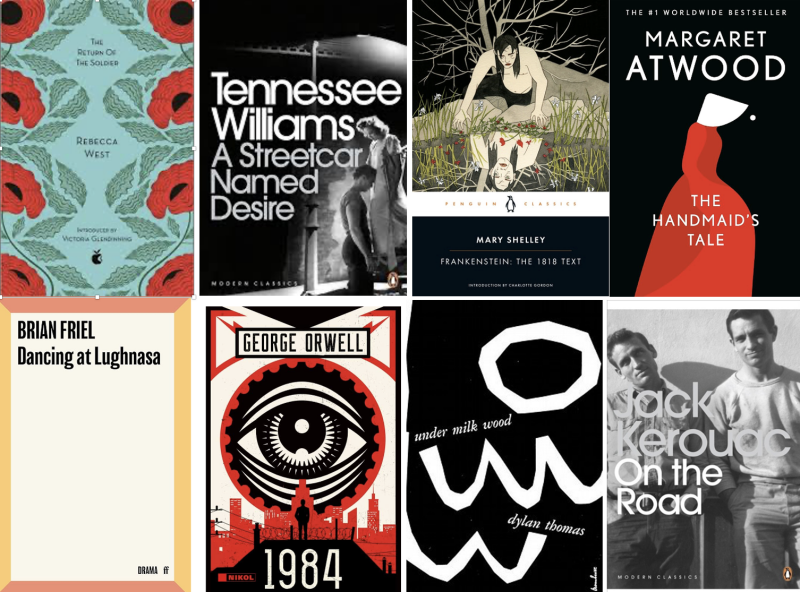
- à titre d’exemple, œuvres étudiées en 2024-2026 :
- Hamlet – pièce de Shakespeare
- Great Expectations – roman de Charles Dickens
- Under Milk Wood – pièce de Dylan Thomas
- The Bloody Chamber – recueil de nouvelles d’Angela Carter
- Northanger Abbey – roman de Jane Austen
- 6 poèmes (Dickinson, Poe, Radcliffe, Tennyson, Browning, Keats)
Histoire-géographie en anglais
- En seconde SI: https://www.education.gouv.fr/bo/22/Hebdo27/MENE2217153N.htm
Connaissance du Monde (en 1ère et Terminale)
Projet de recherche mené sur 2 ans
Subjects taught in the British Section / Syllabus
English Language & Literature (ACL)
- The literature component is examined and assessed at a level equivalent to A-level English Literature, and is based on the study of texts with a similar level of challenge to those set for A-levels.
- In terms of writing, the BFI English examination demands responses in essay form to A-level style questions about works of literature. Qualities of argument, control of formal and critical language, structure, and clarity of expression are assessed, as well as the analytical and personal response to literature.
- In terms of reading, the BFI English written and oral examinations assess the student’s response to and analysis of 5 complex whole literary works, including a Shakespeare play, and a set of poems. The study of texts includes a synoptic unit (currently either ‘Dystopian Writing’ or ‘Coming-of-Age narratives’).
History – Geography
- The BFI History Geography exam assesses both the French and the British curriculum, allowing pupils to develop their critical thinking skills and prepare them for higher education.
- https://www.asiba.fr/history-and-geography-programmes/
Connaissance du Monde: a research project conducted over 2 years, in 1ère and Terminale
- The main aim is to develop research, study and communication skills, whilst developing the student’s awareness of aspects of the cultural characteristics of their section
- Students are to undertake a research project on a subject of their choice, which involves an international partner
- The student’s research project should be developed from one of three paths of reflection
- 2 hours a week in 1ère and Terminale
- https://www.asiba.fr/cdm-programme/
These extra subjects are examined in English at first-language level and certified by Oxford as equivalent to A-Level standard.
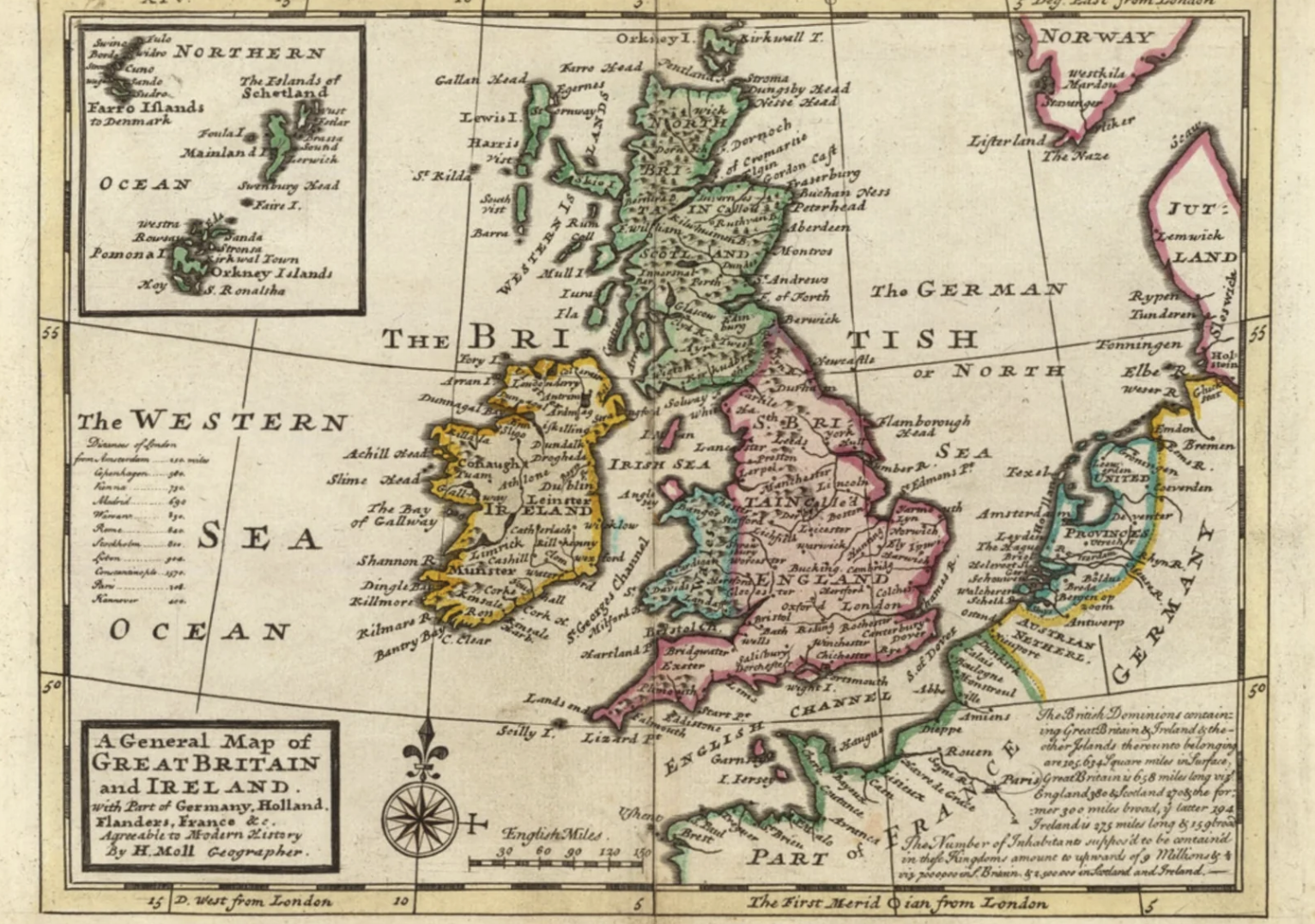

Informations (en anglais) sur les Sections britanniques : Programme, examens, perspectives universitaires
BFI (Bac Français International)
Examens spécifiques en Terminale
5 examens supplémentaires dans 3 matières, en plus des épreuves du baccalauréat général :
- Littérature anglophone (coefficient 20): épreuve écrite de 4h / examen oral de 15 min
- Histoire-Géographie (coefficient 20): épreuve écrite de 4h / examen oral de 15 min
- Connaissance du Monde (coefficient 20): examen oral de 20 minutes
L’ensemble des coefficients des enseignements spécifiques au BFI s’élève à environ 40% de la note finale au baccalauréat.
Informations officielles sur Éduscol:
https://eduscol.education.fr/3043/baccalaureat-francais-international-bfi
The BFI (British version)
Specific Final Exams
5 Examinations in 3 subjects are added to the full syllabus of the French Baccalaureate:
- English Language & Literature: 4-hour written exam / 15-minute oral exam
- History–Geography: 4-hour written exam / 15-minute oral exam
- Connaissance du Monde: 20-min oral exam
The linguistic demands of these exams are focused on the use of English in an academic context; this makes them an excellent preparation for university study in any subject.
The levels of linguistic achievement for successful candidates are C1 or C2 on the CEFR, or ‘educated native speaker/writer’.
Profil des élèves
Il n’est pas nécessaire d’être parfaitement bilingue ou d’être un locuteur natif pour rentrer en section britannique.
Par contre, nous recherchons des élèves qui :
- ont un solide niveau d’anglais (niveau B2 du CECRL à l’entrée en Seconde).
- ont un intérêt marqué pour la lecture et la littérature, le débat d’idées et les sciences humaines.
- sont très motivés, et sont prêts à s’investir pleinement dans le travail scolaire.
Requirements and student profile
To join the British Section, you don’t have to be a native speaker or fully bilingual.
But you do need to love English and to enjoy reading, discussion and debating.
You should be fully engaged in your studies, and willing to work hard.
We are looking for students:
- who are proficient speakers in English
- with the ability to argue, to give and defend opinions
- with strong motivation and a keen interest in reading, discussion and literature
- with strengths in English and History-Geography
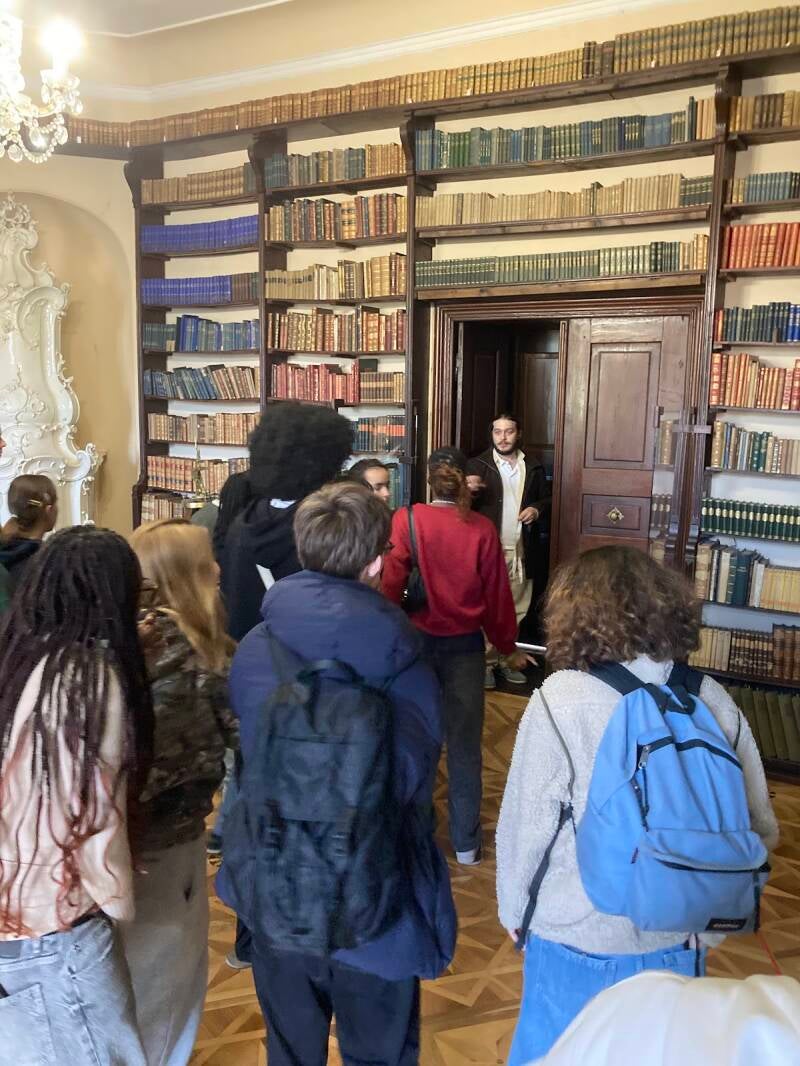
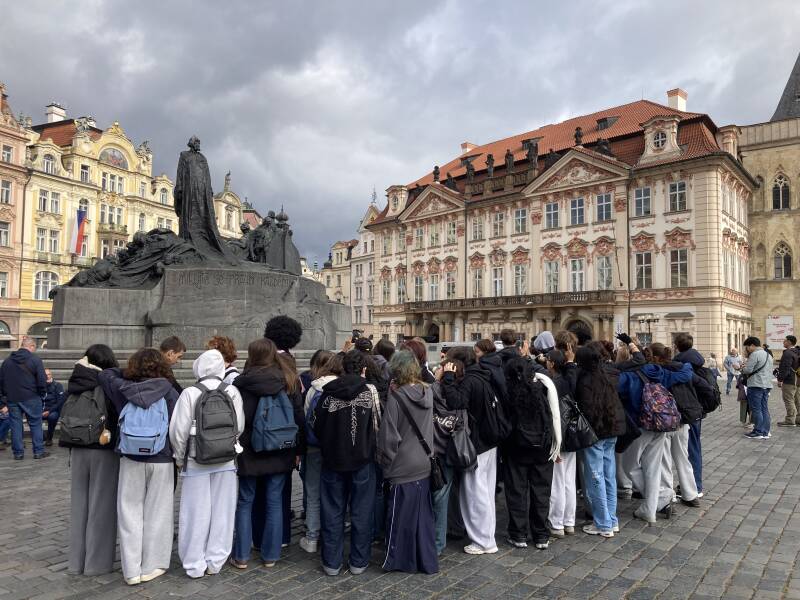
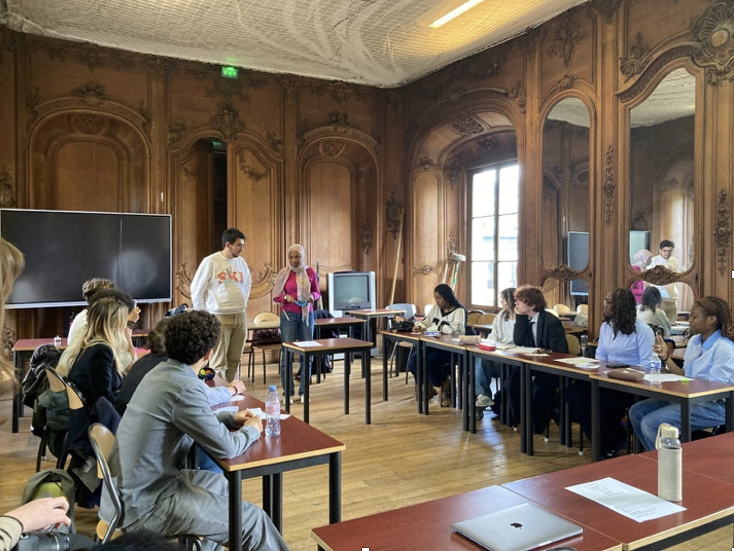
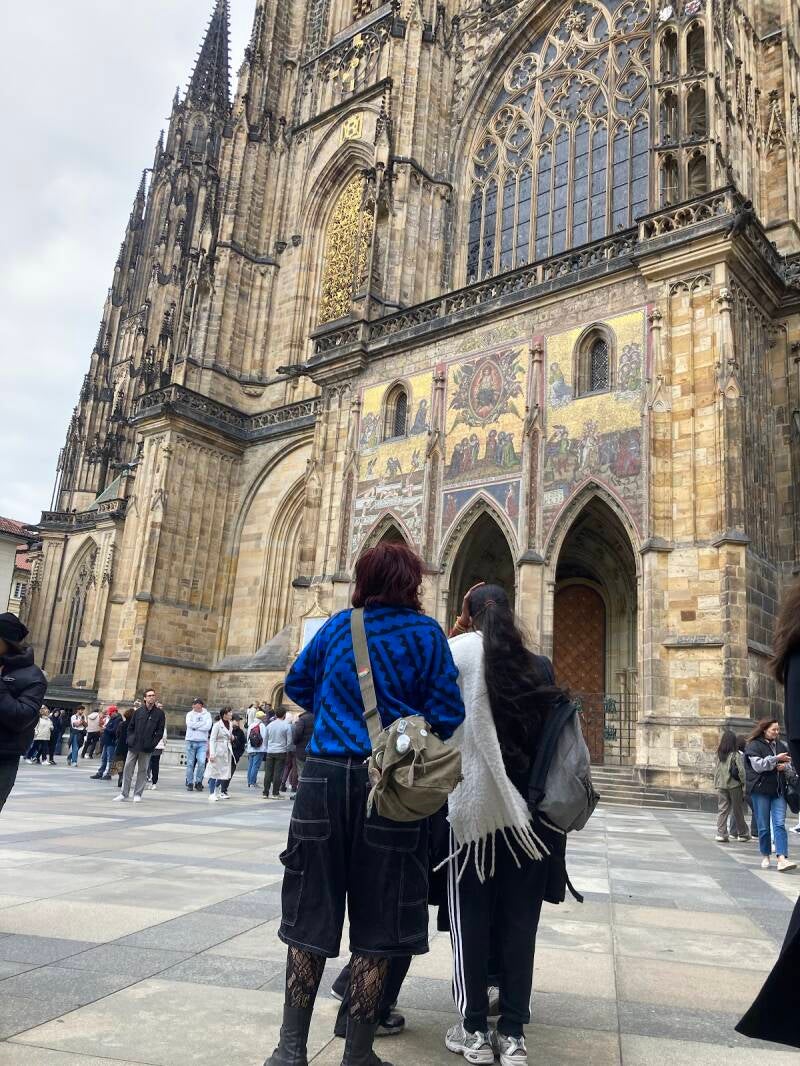
Quelques projets menés depuis l’ouverture de la section en 2023-2024:
Some projects of the British Section at the Nouveau Lycée de Vincennes
- organisation d’une Conférence Climat (COP)
- organisation d’un MUN (Model of United Nations)
- Club Débats (FDA Debate Club) – ateliers / débats avec des élèves d’autres établissements
- Partenariats avec un lycée au Danemark et en République tchèque
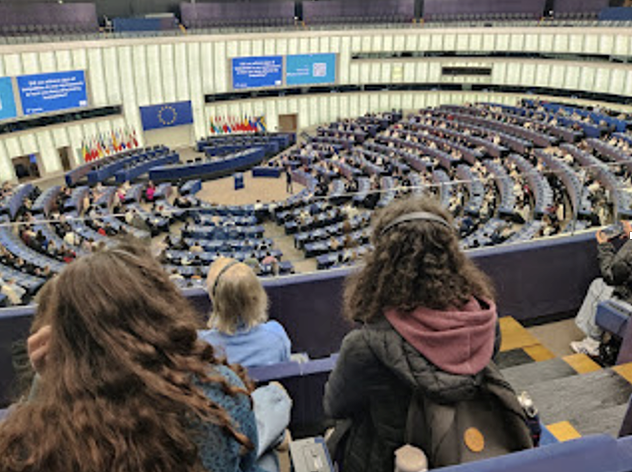
- Voyages à Strasbourg, à Bruxelles, au Danemark, en République tchèque
- Accueil d’élèves groenlandais, tchèques, lituaniens et danois
Pour plus de détails sur les activités et projets menés, voir le blog British Section Vincennes
https://britishsectionvincennes.blogspot.com/p/programmes_26.html
- organising a Climate Conference (COP)
- attending and organising a MUN (Model United Nations)
- Debate Club (workshops and debates with students from other schools, with the FDA - French Debating Association)
- Partnerships with High Schools in Denmark and the Czech Republic
- Trips to Strasbourg, Brussels, Denmark, the Czech Republic
- Hosting pupils from Greenland, the Czech Republic, Lithuania, Denmark
To find out more about past projects, check out the blog British Section Vincennes
https://britishsectionvincennes.blogspot.com/p/programmes_26.html

Conditions d'admission
L'admission en section britannique est soumise à un concours rigoureux. La constitution du dossier s'effectue au mois de janvier, suivie d'une épreuve écrite en mars et d'un oral en mai. Restez informé quant aux dates précises pour ne manquer aucune étape essentielle.
Voici les dates pour la rentrée 2026:
- du 4 décembre au 26 janvier 2026 - Communication et constitution des dossiers de candidature
- mercredi 18 mars 2026 - Test d'admissibilité (après-midi): épreuve écrite d'1h30
- mai 2026 - Test d'admission / Passage de l'épreuve orale: épreuve de 15 minutes
Informations sur la procédure:
https://orientation.ac-creteil.fr/wp-content/uploads/2025/12/17.-Fiche-sections-internationales.pdf
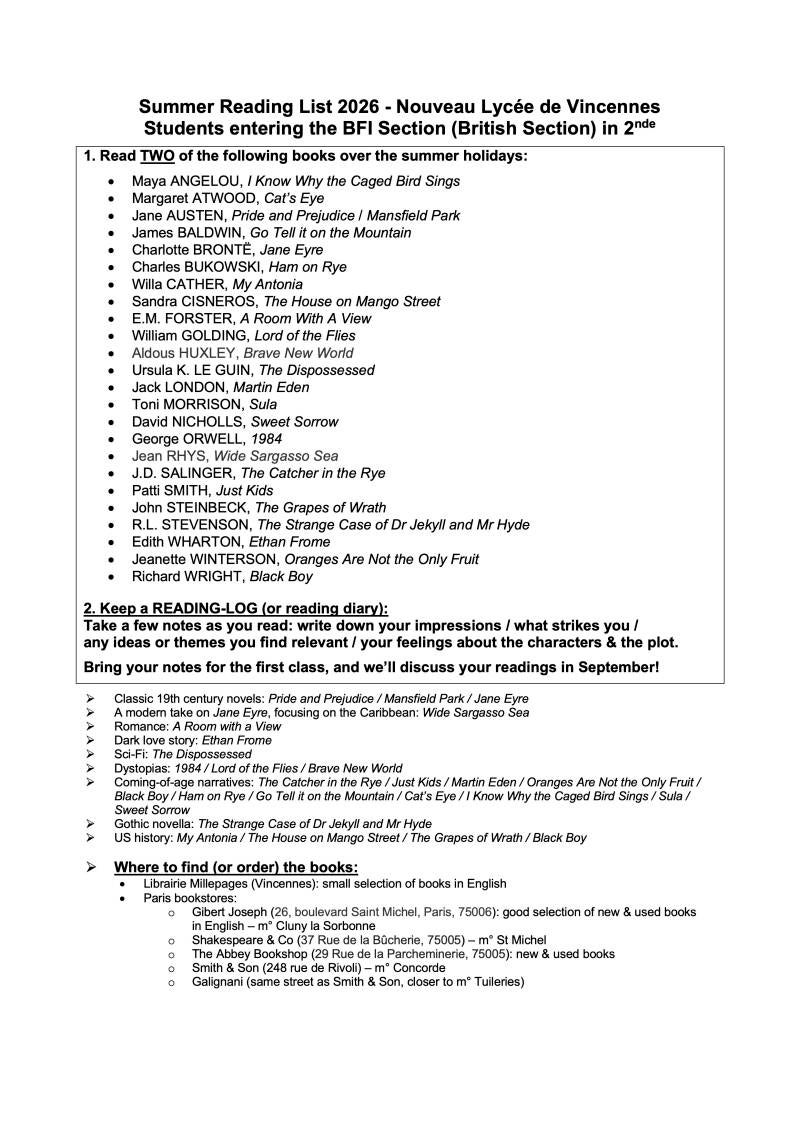
Liste de Lecture en Littérature: entrée en Seconde / Reading List for Seconde students
How to apply
Admission to the British Section is subject to a rigorous process.
Application files are to be submitted in January, followed by a written exam in March and an oral exam in May.
Stay informed about specific dates so you do not miss any essential steps. Here are the dates for 2026 :
- December 4 to January 26, 2026 – Opening of the application process
- Wednesday, March 18, 2026 – Entrance exam (afternoon): 1.5-hour written exam
- May 2026 – Admissions test / Oral exam: 15-minute exam
Further information:
https://orientation.ac-creteil.fr/wp-content/uploads/2025/12/17.-Fiche-sections-internationales.pdf
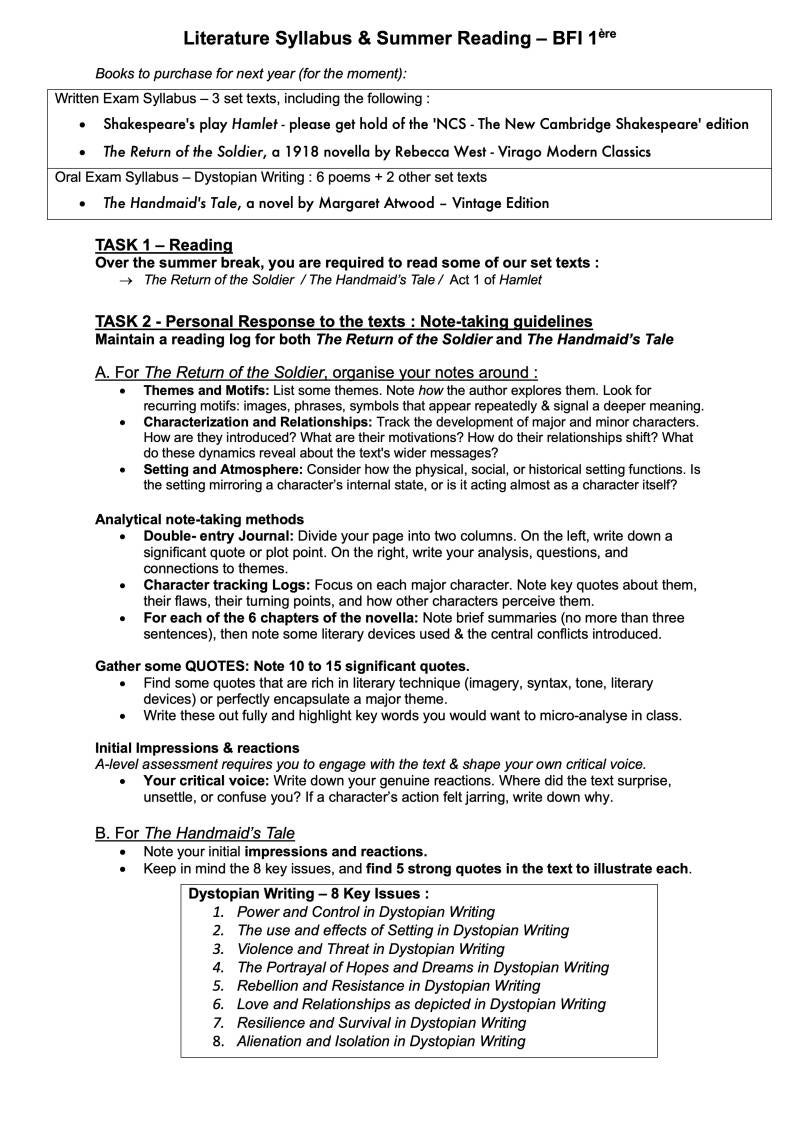
Summer Homework in Literature for Students entering 1ère - September 2026
Une immersion culturelle mondiale enrichissante
La Section Internationale ne se limite pas à l'apprentissage linguistique. Elle offre une véritable immersion culturelle grâce à des projets éducatifs mondiaux, des voyages scolaires et des partenariats avec des établissements étrangers variés, préparant ainsi les élèves à devenir des citoyens du monde accomplis.